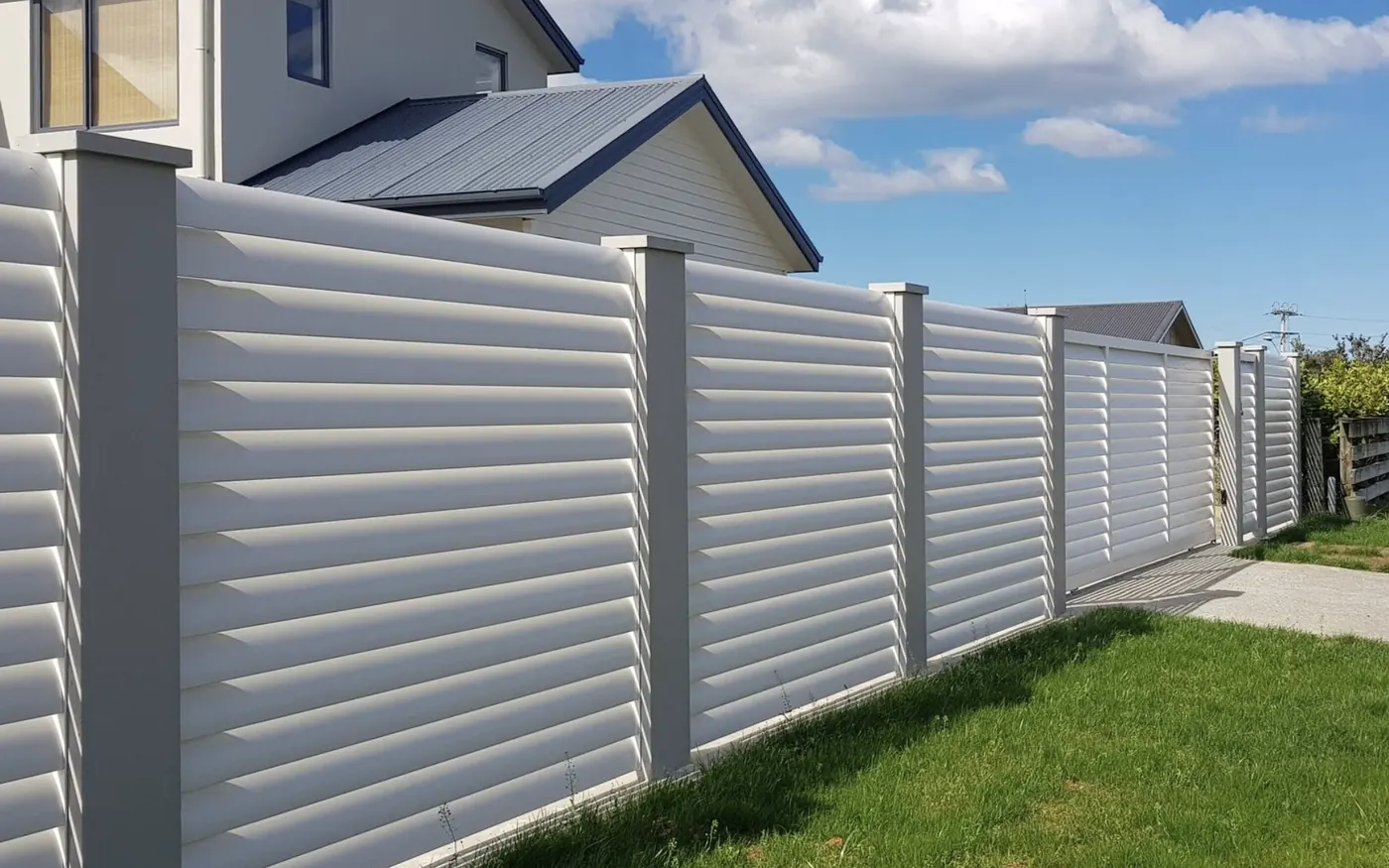
In short
- No building consent is needed for a fence up to 2.5 m high.
- District plans often set lower limits, especially on the street boundary.
- Subdivision covenants can be stricter than both.
- Always confirm the height for your address with your council.
A fence up to 2.5 metres high can be built in Christchurch without a building consent. That is the Building Act rule and it applies across New Zealand. It is only the first of three layers. The district plan for your area can set a lower limit, particularly along the street, and a covenant on your title can be stricter again. A fence has to satisfy all three.
Layer one: the Building Act
Schedule 1 of the Building Act 2004 lists building work that does not need a consent. It includes fences up to 2.5 metres in height above the supporting ground. Two points go with that:
- The work must still comply with the Building Code. The fence has to be sound and must not fall over.
- The exemption does not cover pool barriers. Those are dealt with separately and normally need a consent.
A fence higher than 2.5 metres needs a building consent, and in a residential area it will almost certainly run into planning rules as well.
Layer two: the district plan
District plans are about how neighbourhoods look and work: sunlight, outlook, the feel of the street and safety. Greater Christchurch has three:
- Christchurch District Plan for the city and Banks Peninsula, run by Christchurch City Council.
- Selwyn District Plan for Rolleston, Lincoln, Prebbleton and West Melton, run by Selwyn District Council.
- Waimakariri District Plan for Rangiora, Kaiapoi, Woodend and Pegasus, run by Waimakariri District Council.
The detail differs by plan and by zone, and all three plans have been under review in recent years, so do not rely on a figure from a neighbour or an old website. The themes are consistent, though.
Front fences
Fences along the road boundary are the ones most often restricted. Plans commonly hold them lower than side and rear fences, or require the upper part to be see-through, so houses still face the street and people on the footpath can be seen. As a rough guide, limits somewhere between 1 and 2 metres are typical, depending on the zone and how solid the fence is.
Side and rear fences
Ordinary boundary fences between neighbours of up to about 2 metres are generally accepted. Above that height, a fence can start to be treated as a building under the plan, which brings in rules on setbacks and on shading the neighbour.
Special areas
Character areas, heritage settings, properties beside rivers and reserves, and medium-density zones often have their own fencing rules. Corner sites usually have to keep a clear view across the corner for traffic.
If a proposed fence does not meet the plan, it may still be possible with a resource consent. That costs money and takes time, and it is not guaranteed.
Layer three: covenants
Most sections created in the last twenty to thirty years have covenants registered on the title by the developer. In Rolleston, Lincoln, Halswell, Wigram, Belfast, Rangiora, Kaiapoi and Pegasus they are the rule, not the exception. Fencing clauses commonly include:
- A maximum height, often lower than the district plan would allow.
- No fencing forward of the front wall of the house.
- Approved materials and colours, sometimes a single specified style.
- Open or low fencing on boundaries facing reserves, walkways and stormwater areas.
- A clause that the developer does not contribute to fencing costs.
Covenants are private agreements. The council does not enforce them, and other owners in the subdivision can. They sit in the title documents your lawyer gave you at settlement, and a copy can be ordered from Land Information New Zealand.
How height is measured
Height is generally measured from the ground at the base of the fence. Where the ground level differs on each side, expect the measurement to be taken from the lower side, since that is the side that looks at the taller structure. This catches people out in three situations.
- Fences on retaining walls. A 1.8 metre fence on top of a 1 metre wall is 2.8 metres from the lower side. That is over the consent threshold and well over most planning limits.
- Sloping boundaries. A stepped fence is higher at the low end of each bay than at the high end.
- Trellis and screens. Trellis or a slatted extension fixed to the top of a fence counts as part of its height.
Separately, where someone could fall a metre or more from the top of a wall, a barrier is required for safety. On Port Hills sections in Cashmere, Westmorland and Sumner, the wall, the barrier and the fence often have to be designed together.
Pool fences
Pool barriers have minimum heights, not maximums: at least 1.2 metres, and generally 1.8 metres on the pool side where a boundary fence forms part of the barrier. See the pool fencing rules guide.
What about the neighbour?
None of these rules give your neighbour a veto over a fence that complies. On a shared boundary, though, the fence is normally a joint one under the Fencing Act 1978. They only have to contribute to an adequate fence, and a 2 metre or higher fence may be more than adequate. If you want extra height and they do not, the usual result is that you pay the difference. See the Fencing Act guide.
A hedge is not a fence. Hedge heights are not controlled by these rules, though a covenant may cover them, and there is a separate court process for trees that seriously affect a neighbour.
How to check the height for your address
- Find your zone. Each council has an online district plan map. Search your address and note the zone and any overlays.
- Read the fencing rule for that zone, or ring the council's duty planner and ask what the limit is for front, side and rear fences at your address. It is a free call, and it is their job to answer.
- Check your title for covenants and consent notices.
- Measure from the lower side if the levels differ.
- Tell your fencer what you found, so the quote is for a fence you can build.
Confirm with Christchurch City Council, Selwyn District Council or Waimakariri District Council before you commit. A fence that breaches the plan or a covenant can be required to come down, and the cost of that falls on the owner. For a price on a fence at the height you settle on, try the fence cost calculator.
Common questions
How high can a fence be in Christchurch without consent?
Up to 2.5 metres without a building consent. The district plan and any covenant on your title can set lower limits, particularly for front fences, so check those before building.
How high can a front fence be in Christchurch?
It depends on the zone and on how solid the fence is. Front fences are commonly held lower than side and rear fences or required to be partly see-through. Ask Christchurch City Council for the rule at your address.
Does a fence on top of a retaining wall count as one height?
Usually yes. Height is generally measured from the lower ground, so the wall and the fence are added together. Confirm how your council measures it.
Can my neighbour stop me building a 2 metre fence?
Not if it complies with the district plan and any covenant. On a shared boundary they only have to contribute to an adequate fence, so you may need to pay for the extra height yourself.